Story by Sherine Atieno and Photos by Ondari Ogega
After years of discomfort and uncertainty following childbirth, 27-year-old Sela Awiti Oginga now looks ahead with renewed confidence and dignity. Thanks to corrective surgery received during the ongoing free fistula camp at Jaramogi Oginga Odinga Teaching and Referral Hospital (JOOTRH), the young mother says she is finally on the path to healing.
Ms. Awiti, a resident of Nubian Estate and a mother of one, delivered her first child three years ago. While the birth itself brought joy, complications that followed left her struggling with a condition she had never anticipated.
“I had a third-degree perineal tear during delivery, but it was not properly repaired,” she recalls. “After that, I started experiencing urine incontinence. Sometimes I could not hold urine for long periods, which made daily life very uncomfortable.”
At first, the experience left her confused and anxious. As a first-time mother, she had little understanding of what was happening to her body.
“I knew about fistula in general terms, but my situation felt different,” she explains. “It was frightening at the beginning because I had never experienced anything like that.”
Despite the challenges, Ms. Awiti found strength in the unwavering support of her family. Her mother, encouraged her to seek medical attention and helped her access care.
“My family has been very supportive. My mother encouraged me to come to the hospital and even helped with transport so that I could seek treatment,” she says.
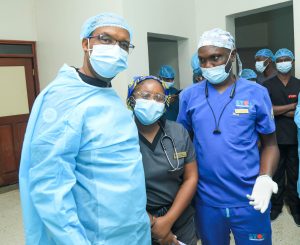
During one of her visits to JOOTRH, Ms. Awiti spoke with a doctor who informed her about the upcoming fistula repair camp, a partnership between M-PESA Foundation and Flying Doctors of Africa, scheduled for 27th February to 6th March. Determined to find a solution, she enrolled in the program and later underwent corrective surgery.
Now recovering, Ms. Awiti says the procedure has already made a significant difference in her life.
“I’m feeling much better now,” she says with relief. “Even though there is still some pain, I know things are improving.”
Before the surgery, the condition had begun affecting her daily routine. An active person who enjoys exercising, Ms. Awiti found it difficult to continue activities such as going to the gym or lifting heavy items due to the discomfort.
Today, she hopes her experience will encourage other women facing similar conditions to seek help.
“Many mothers suffer in silence because they are afraid to speak about these issues,” she says. “But this condition is treatable and preventable. Women should come forward and seek medical care.”