Story by Eddah Macharia and Pauline Monica and Photos by Ian Obadha
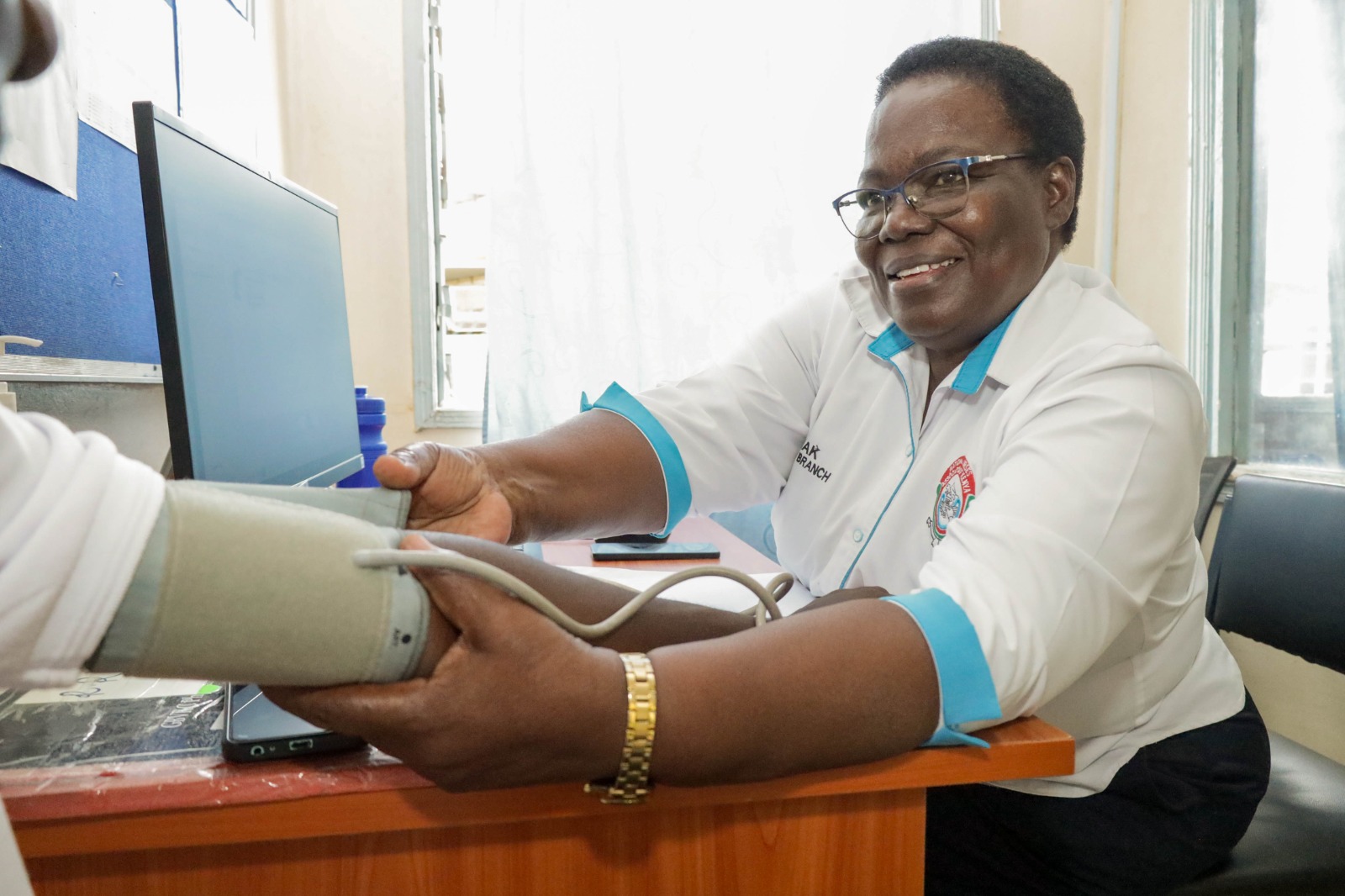
For Risper Ogwe, nursing was never a fallback plan; it was a calling sparked by the sight of starched white uniforms and flowing capes. Growing up near Homa Bay District Hospital, she would stand by the roadside during school breaks, watching nurses pass with an air of confidence and care. That spark was fanned into a flame by her stepmother, a nurse whose generosity knew no bounds.
“She would work on patients regardless of her time or the weight of her own pocket,” Risper recalls. “Sometimes she would even buy food for vulnerable patients. I admired passion and knew I wanted to be just like her.”
Despite her father’s wishes for her to pursue teaching, Risper followed her heart. After a brief one-year stint in a classroom, she enrolled at Kisumu Medical Training College in 1987. By 1990, she was posted to JOOTRH, beginning a journey that remains unbroken to this day.
Throughout her career, Risper has seen it all. However, it was her time in the Accident and Emergency department that reshaped her mission. She noticed a recurring heartbreak: survivors of sexual and gender-based violence (SGBV) often felt lost in the chaos of a crowded emergency room. “I realized they needed more than medicine; they needed emotional sanctuary,” she says.
Driven by this need, Risper took the initiative to pursue specialized training in counseling and trauma. Today, she manages the hospital’s Gender-Based Violence Recovery Centre (GBVRC), a space where “emotional wellness” is the priority—not just for patients, but for the staff who carry their burdens.
In a profession often characterized by clinical detachment, Risper is a vocal advocate for the humanity of health workers. “People think nurses are hard-hearted, but nurses also cry,” she says. “We are human beings with feelings.” She notes that the landscape of nursing has shifted drastically since 1990. While digital records and improved infection control have modernized care, the sheer volume of patients has created a mounting pressure on a lean workforce. Yet, she remains anchored by the “first step” of healing: Love
Despite the gravity of her work at the GBVRC, Risper is known among colleagues for her infectious positivity. Her coworkers affectionately call her “the laughing machine,” a testament to the cheer she maintains in the face of trauma.
Her impact is perhaps best measured in the lives she has influenced. Years ago, Risper cared for a young boy and encouraged him to believe in his potential. Today, that boy is a clinical officer. Whenever they meet in the hospital corridors, it serves as a reminder that a nurse’s influence extends far beyond the ward.
As she reflects on over 30 years of service, Risper is now focused on the next generation. “What is good in me, I should pass on to others,” she says.
As Nurses Week celebrations continue, Risper Ogwe stands as a reminder that beyond the medication and the procedures, the heart of healthcare remains a human one. For her, nursing isn’t just a job—it is a lifelong commitment to the dignity of the human spirit.