Story by Sherine Atieno and Photos by Ondari Ogega
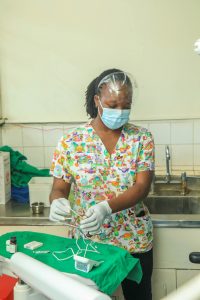
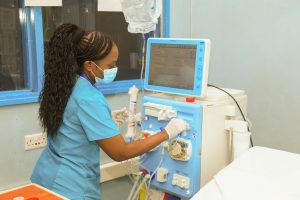
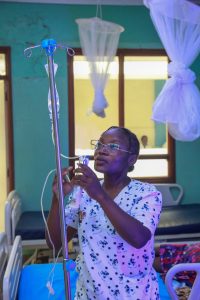
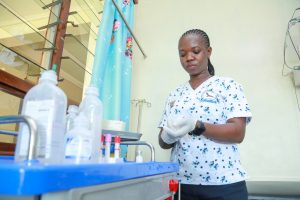
Medical experts are raising a vital alarm over a common habit among healthcare professionals that could be fueling the spread of deadly, drug-resistant “superbugs” within the community: the practice of wearing hospital scrubs in public spaces.
While often seen as a badge of professional identity or a matter of convenience, wearing clinical attire in markets, buses, or restaurants effectively creates a bridge for dangerous pathogens to travel from the hospital environment directly into the public.
A leading researcher at the Jaramogi Oginga Odinga Teaching and Referral Hospital (JOOTRH) has issued a stern warning regarding this growing threat of Antimicrobial Resistance (AMR). In a recently published study titled “Antimicrobial Resistance (AMR) Across a One-Health Framework,” Silas O. Awuor of the JOOTRH Microbiology Department argues that hospital attire worn outside clinical settings acts as a significant vector for environmental contamination.
This research comes at a critical juncture; in 2023 alone, approximately 1.27 million deaths globally were attributed to AMR—a “silent pandemic” where bacteria and viruses no longer respond to standard medicines. Awuor, who is also affiliated with Kisii University, notes that the misuse of antimicrobials across human, veterinary, and agricultural sectors has caused resistance rates to rise sharply, threatening both lives and regional food security.
The inspiration for this study was born from a simple observation. While commuting to JOOTRH, Dr. Awuor watched four healthcare workers board a matatu still dressed in their night-shift scrubs. While fellow passengers looked on with respect, acknowledging them as “daktari,” the microbiologist saw a different story: the potential for unseen microorganisms to hitchhike from the hospital into the shared space.
His subsequent findings, co-authored with Eric O. Omwenga and published in the Annals of Bacteriology Research, suggest that simple behavioral changes could be a vital step in mitigating this risk.
Evidence shows that scrubs become contaminated through routine exposure to patients, surfaces, and bodily fluids. Even with diligent hand hygiene, the frequent contact involved in accessing pockets or adjusting the uniform leads to repeated contamination. The study also highlights a hidden danger at home; many health workers wash their scrubs with the family laundry, creating a pathway for pathogens to enter their own households. This contradicts guidance from the Occupational Safety and Health Administration (OSHA), which advises against removing contaminated attire from controlled settings.
As JOOTRH continues its transition into a National Level 6 facility, the research underscores the urgent need for stricter institutional policies and improved infrastructure. The hospital environment serves as a reservoir for resistant bacteria, and when staff move into non-clinical areas without changing, they create a pathway for these bacteria to reach public surfaces, food, and water.
To combat this, the study calls for hospitals to strictly prohibit the use of clinical attire outside the workplace, while simultaneously providing adequate changing rooms and professional laundry services so staff are not forced to take their work clothes home.
Ultimately, AMR is not contained within hospital walls; it is an environmental and public health crisis. As Kenya battles the rise of resistant infections, the simple act of changing clothes before leaving the hospital could prove to be a vital defense in protecting the community from the next generation of untreatable diseases.